How AI Assistants Can Reduce Customer Support Workload
Learn how AI assistants help businesses reduce repetitive support requests, improve response speed, and give customers better answers across channels like websites and WhatsApp.
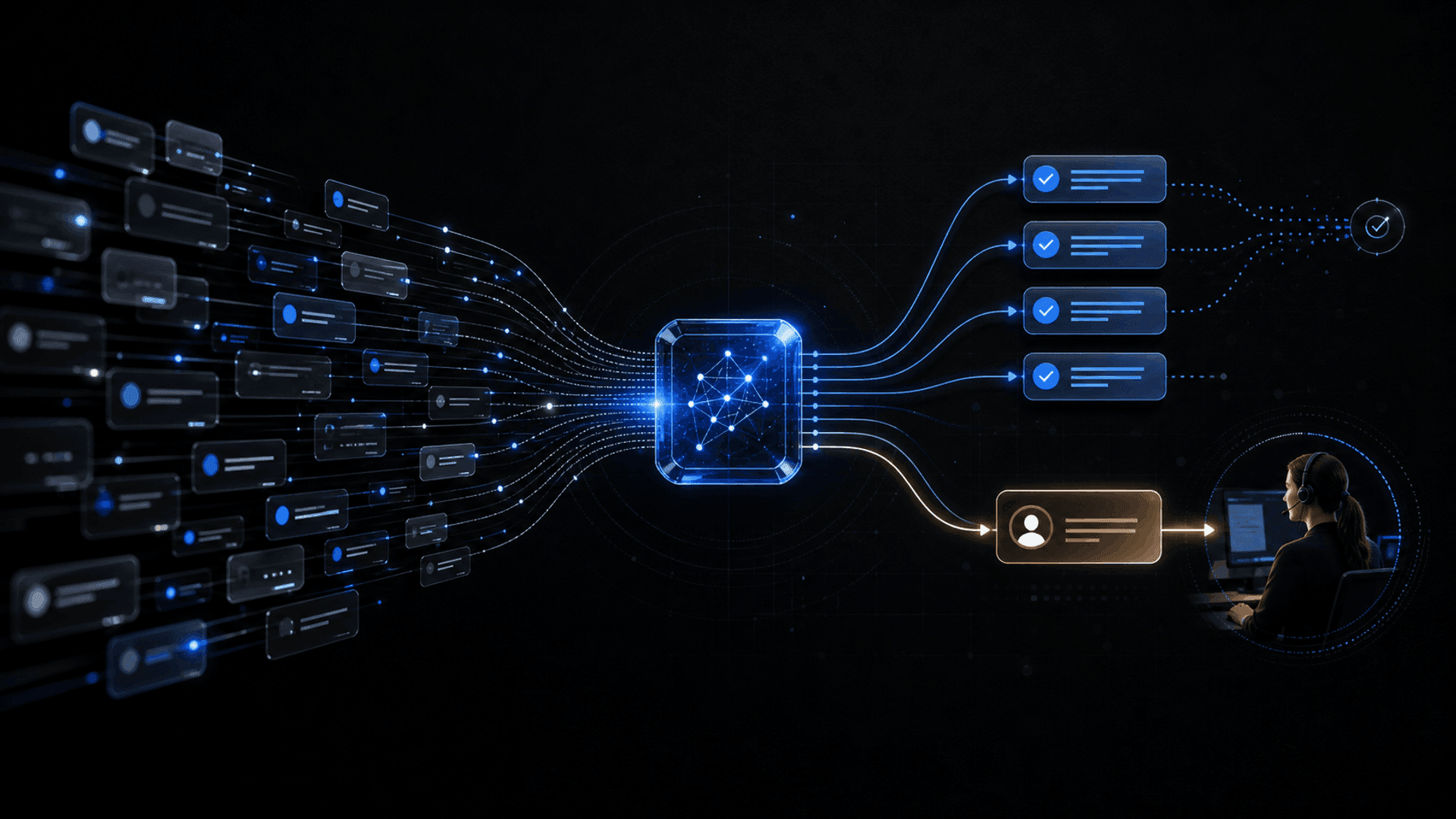
Customer support teams are under more pressure than ever.
Customers expect fast replies. They ask questions across websites, WhatsApp, social media, email, and live chat. At the same time, many support teams spend a large part of their day answering the same questions again and again.
Questions like:
- What are your prices?
- How can I book?
- What is the order status?
- What documents are required?
- Can I speak to someone?
- What services do you provide?
- How do I apply?
- What are the next steps?
These questions are important, but answering them manually every time can slow down the team and create delays for customers.
This is where AI assistants can create real business value.
A well-designed AI assistant can reduce repetitive support workload, answer common questions, organize requests, and help human teams focus on conversations that need real attention.
What is an AI customer support assistant?
An AI customer support assistant is a digital assistant designed to understand customer questions and respond with helpful answers based on your business information.
It can be used on:
- Websites
- Mobile apps
- Customer portals
- Internal dashboards
- Social messaging channels
Unlike a basic chatbot with fixed buttons, an AI assistant can understand natural language, search business knowledge, and guide users through different support journeys.
For example, a customer may ask:
“I want to know the documents needed to apply.”
Instead of forcing the customer to click through many options, the assistant can understand the question and provide the right answer immediately.
Why customer support teams become overloaded
Support workload usually increases when businesses grow.
More customers means more questions. More services means more details. More channels means more messages to manage.
The problem is that many support teams still depend on manual replies, scattered files, and individual knowledge.
This creates several challenges:
- Slow response times
- Repeated questions
- Missed messages
- Inconsistent answers
- Team burnout
- Higher support costs
- Poor customer experience
- Too much dependency on specific employees
AI assistants help reduce this pressure by handling repetitive conversations and routing important cases to the right people.
How AI assistants reduce support workload
1. Answering repeated questions automatically
Most businesses receive repeated questions every day.
An AI assistant can handle common questions about services, pricing, policies, booking, delivery, documents, availability, timelines, and next steps.
This reduces the number of manual replies your team needs to send.
The result is simple:
Customers get faster answers.
Support teams get fewer repetitive tasks.
2. Helping customers before they contact the team
Many customers contact support because they cannot find information easily.
An AI assistant can act as a smart front layer on your website or WhatsApp channel, helping customers find answers before they need a human agent.
This can reduce unnecessary support tickets and make the customer journey smoother.
For example, instead of sending a message and waiting for a reply, the customer can ask the assistant:
“What service is best for my company?”
The assistant can guide them based on available information and then suggest the next step.
3. Collecting customer information before human follow-up
Support teams often waste time asking basic questions before they can help.
An AI assistant can collect important details such as:
- Name
- Phone number
- Service needed
- Request type
- Budget range
- Location
- Preferred time
- Problem description
- Required documents
Then it can pass this information to the human team in a structured format.
This makes follow-up faster and more organized.
4. Routing requests to the right team
Not every customer message should go to the same person.
Some requests are for sales. Others are for support, operations, finance, technical help, or management.
An AI assistant can classify requests and route them to the right department or workflow.
For example:
- Pricing question → Sales
- Technical issue → Support
- Payment problem → Finance
- Application request → Operations
- Partnership inquiry → Business development
This reduces confusion and improves response quality.
5. Supporting agents with suggested answers
AI assistants do not only help customers directly. They can also support the internal team.
An internal AI assistant can help support agents find the right answer faster from company documents, policies, FAQs, and previous cases.
Instead of searching manually, the agent can ask:
“What should I tell a customer asking about cancellation?”
The assistant can retrieve the approved answer and help the agent respond faster.
This improves consistency and reduces training time for new team members.
6. Working across multiple channels
Customers do not use one channel only.
They may contact your business through WhatsApp, website chat, Instagram, email, or a customer portal.
A strong AI assistant strategy can help unify these conversations and create a more consistent support experience.
For many businesses in MENA, WhatsApp is especially important because customers often prefer direct messaging over forms or email.
An AI assistant connected to WhatsApp can help businesses respond faster, qualify requests, and reduce missed opportunities.
What AI assistants should not do
AI assistants are powerful, but they should not be used carelessly.
A good AI support assistant should not pretend to know everything. It should not give unsupported answers, expose private data, or replace human judgment in sensitive situations.
The assistant should know when to:
- Answer directly
- Ask for more information
- Show a trusted source
- Escalate to a human
- Say that the answer is not available
- Route the request to the right team
The goal is not to remove humans from support.
The goal is to make human support more efficient, focused, and scalable.
When does your business need an AI support assistant?
Your business may need an AI assistant if:
- Your team answers the same questions every day
- Customers complain about slow replies
- WhatsApp messages are hard to manage
- Leads are lost because no one responds quickly
- Support agents depend on scattered documents
- New employees take too long to learn support answers
- You want to reduce manual work without reducing service quality
- Your company receives many requests from different channels
- You need more consistent answers across the team
If support workload is growing faster than your team can handle, an AI assistant may be a practical first step.
Examples of AI assistant use cases
Recruitment and domestic services
An AI assistant can answer questions about available services, required documents, application steps, request status, contracts, and follow-ups.
It can also collect customer requests and route them to the right team.
E-commerce and retail
An AI assistant can answer product questions, recommend products, explain policies, help with order status, and reduce repeated support messages.
Education and training
An AI assistant can answer questions from parents, students, and learners about programs, schedules, pricing, admissions, certificates, and progress tracking.
Real estate
An AI assistant can qualify leads, answer questions about properties, collect buyer preferences, and schedule follow-ups with sales teams.
Healthcare and clinics
An AI assistant can help with appointment questions, basic service information, reminders, and routing patient inquiries to the right team.
What makes a good AI support assistant?
A good AI assistant needs more than a chat interface.
It should be designed around real business workflows.
Important elements include:
Clear knowledge base
The assistant needs accurate information about your services, policies, products, and processes.
Human escalation
Customers should be able to reach a human when needed.
Channel integration
The assistant should work where your customers already communicate, such as your website or WhatsApp.
Secure data handling
Customer information should be handled responsibly and protected.
Business workflow connection
The assistant should not only answer questions. It should help create tickets, qualify leads, collect details, or trigger internal workflows.
Continuous improvement
The assistant should improve based on real customer questions and team feedback.
How Evexa can help
Evexa designs and builds AI assistants for companies that want to reduce support workload, improve response speed, and create better customer experiences.
We help businesses:
- Analyze current support workflows
- Identify repeated questions and high-volume requests
- Structure the knowledge base
- Design the assistant conversation flow
- Build AI assistants for websites, WhatsApp, or internal tools
- Connect assistants with CRM, dashboards, forms, or internal systems
- Create escalation workflows for human teams
- Improve the assistant based on real usage
Our goal is not to add a chatbot just because AI is trending.
Our goal is to build a practical assistant that saves time, supports your team, and helps customers get better answers faster.
AI assistants can reduce customer support workload by answering repeated questions, collecting customer details, routing requests, and helping human teams work faster.
For businesses dealing with high message volume, slow replies, scattered information, or overloaded support teams, an AI assistant can be one of the most practical ways to start using AI.
The best results come when the assistant is connected to real business knowledge and designed around real workflows.
Want to reduce repetitive customer support requests?
Let’s build an AI assistant that helps your team respond faster and serve customers better.